vocalize

SELF-GUIDED COMMUNICATION SUPPORT FOR PARENTS

What can I try with my child today?

For parents of late talkers, autistic children and children building early communication skills.

See what to say, what to do and how to adjust during play and everyday routines. Choose from three free examples below.

  • Every way of communicating counts.

    Gestures, signs, sounds, words and AAC are welcome. Keep your child's picture board or communication device available.

  • No lesson screen time for your child.

    The guidance is for you. Read the steps, then try them together.

Planned membership: $19/month or $149/year (USD). Paid enrollment is not open yet.

See plans & pricing

Created by a licensed, experienced speech-language pathologist who has worked with more than 1,000 children.

Vocalize provides parent education and home-practice support. Individual assessment and treatment stay with your child's clinical team.

THREE FREE EXAMPLES · NO SIGN-IN NEEDED

3 minutes, or less if needed

Join their toy-car moment

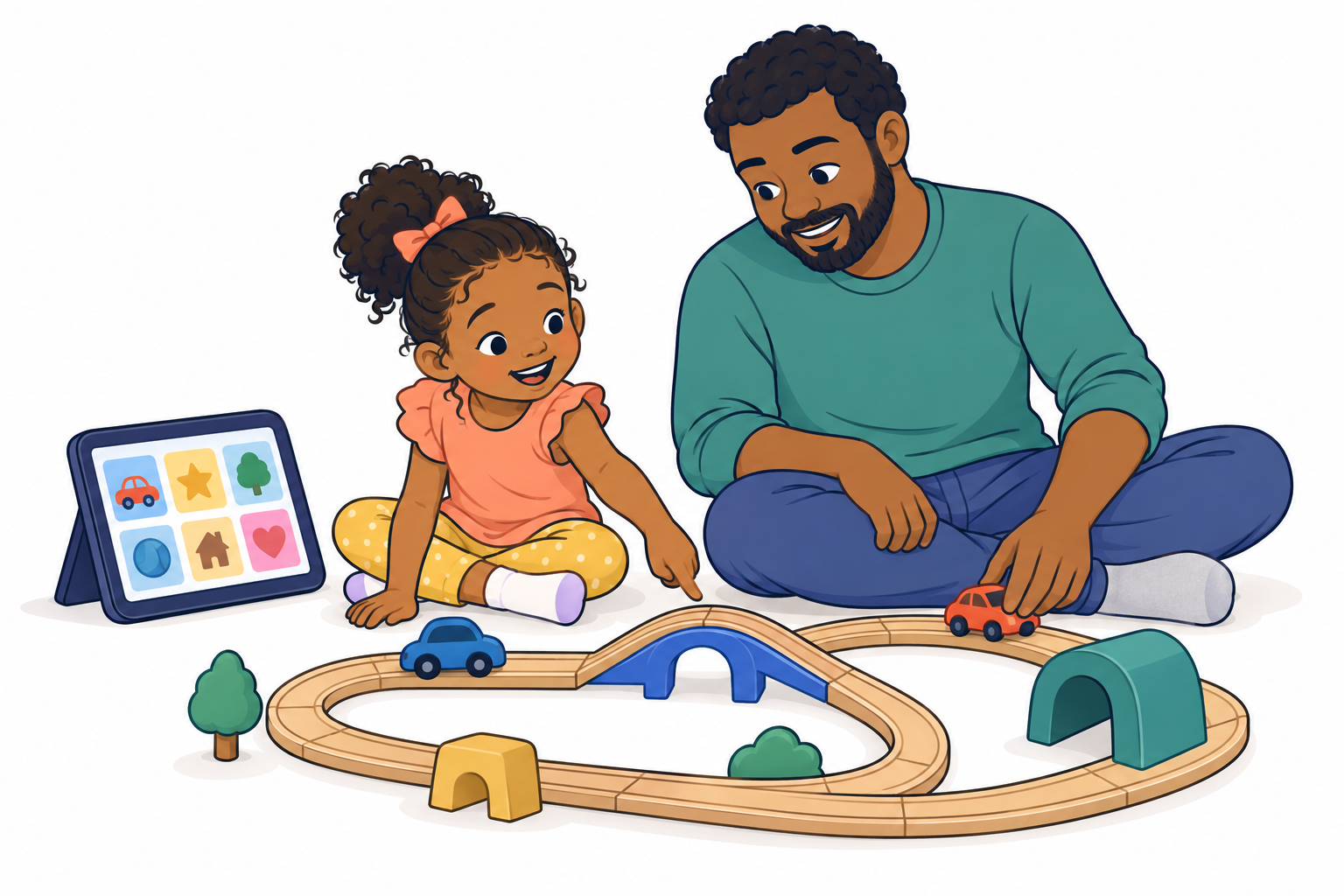
Watch where your child moves their car. Use your own car beside them without taking theirs.

Your car goes over the bridge.

You can read and try this example without a child profile.

A child points toward a toy track while her father plays beside her with his own car. A communication tablet is beside the child.

Follow a visual guide

Pictures and clear examples show what to prepare, what to say and how to adapt.

Try it together

Join your child's interest or invite them into a routine. Welcome their message and give them room for a turn.

Notice one real thing

Keep a real example of what you tried and how your child responded.

RESEARCH BEHIND PARENT-LED COMMUNICATION STRATEGIES

Your everyday interactions matter

Research on teaching parents responsive communication strategies shows benefits for parent–child interaction and aspects of children’s language. These studies explored specific parent-training approaches.

Support for understanding language

In a randomized trial of 97 toddlers with language delays, teaching caregivers communication strategies improved children's language understanding. Caregivers also increased their use of supportive strategies.

Read the study: Roberts & Kaiser · Pediatrics · 2015

In Vocalize, explore a parent strategy, see an example, try it in a familiar routine and reflect on what happened. Choose a useful next step from there.

Explore three illustrated interaction examples

ILLUSTRATED INTERACTION EXAMPLES

See the words and the response

Fictional examples for your own preparation. Explore a child's possible response and what the adult does next, then try one idea in a familiar routine.

A father plays beside a child with separate toy cars; a communication tablet is within the child's reach.

Join, model and leave space

Prepare: Use two large, age-safe toy cars. Keep the child's car and familiar communication supports available.

Notice: The child rolls their car over a bridge. You bring your own car nearby without taking theirs.

Model and act: You say ‘Go’ as your car rolls. If the child uses AAC, also point to or select go on their familiar board or device as you say it.

Leave space: Stop adding words and leave room for a contribution. Keep playing or helping when needed; do not wait for a particular response.

What happens next?

The adult responds

‘Over the bridge!’ Roll your car where they pointed. Respond to the idea without requesting a word.

Your rehearsal: Try one model with your own car, then practice being quiet while leaving everything accessible.

WHY VOCALIZE EXISTS

Know what to say. Know how to respond

Vocalize combines clinical experience with evidence-based communication strategies, including techniques used in milieu teaching: modeling useful language and building on your child's message during everyday play and routines. Parents can see what to say, what to do and how to adjust.

How our approach works

Responsive play and structured teaching

Follow your child's interest or introduce a shared activity. Model a useful word, repeat it naturally, pause and respond to their message. Clear steps, choices and positive encouragement help you teach while respecting your child's communication, comfort and right to say no.

Use your family's language when you practice

The app instructions and downloads are in English. Use your family's languages and dialects when trying communication ideas in play and daily routines.

INSIDE YOUR FAMILY PROGRAM

A plan for today. A place to return tomorrow

Each activity brings together a purpose, clear steps, words to try and ways to adjust. Choose the amount of guidance that helps you.

Time that fits your day

Choose a brief moment or a step-by-step 5-, 10- or 15-minute plan. Longer plans include setup, a break and time to reflect.

Specific help as you practice

See what to do and say, what to notice, and what to try if your child needs something easier or different.

Lessons that explain the purpose

Understand why you are modeling a word, leaving a pause or building on a message, with examples you can use.

Practice you can print

Every activity and lesson has a downloadable companion. Use it offline or add an optional exercise when useful; printing is never required.

An easy return tomorrow

Save an unfinished activity and reopen it from Today. Keep favorites, repeat a useful idea or choose another that fits your time.

A connected learning path

Find a starting point and build on what helps. Start in any phase and revisit it whenever useful.

Six flexible phases

  1. Connect through play
  2. Ask, choose and get help
  3. Take turns and share attention
  4. Build words and sentences
  5. Share stories and ideas
  6. Use skills in everyday life

These are learning areas for parents, not age levels or tests to pass. Start with a family priority and revisit any area. Stories and communication with different people can belong in every area.

See the guidance you'll use

Excerpts from a current activity and parent lesson, plus a page from the printable library.

vocalize Activity guide

ABOUT 5 MINUTES · STOP EARLIER IF NEEDED

Follow their little world

Sit nearby at a comfortable distance. Watch what your child does with the toy. Give them room to choose the activity.

You found the car.
Make this moment smaller

Sit nearby and share one comment about what they enjoy. That is enough today.

vocalize Parent lesson

3-MINUTE PARENT LESSON

Show a message without making it a test

A model is an example you provide. It is different from an instruction to repeat.

Pick a useful message that fits what is happening, such as go, stop, help or funny.

You say ‘Go’ as the car rolls. If your child uses AAC, also point to or select ‘go’ on their familiar communication board or device as you say it. They can watch, gesture, sign, speak or select something else.
vocalize Printable page
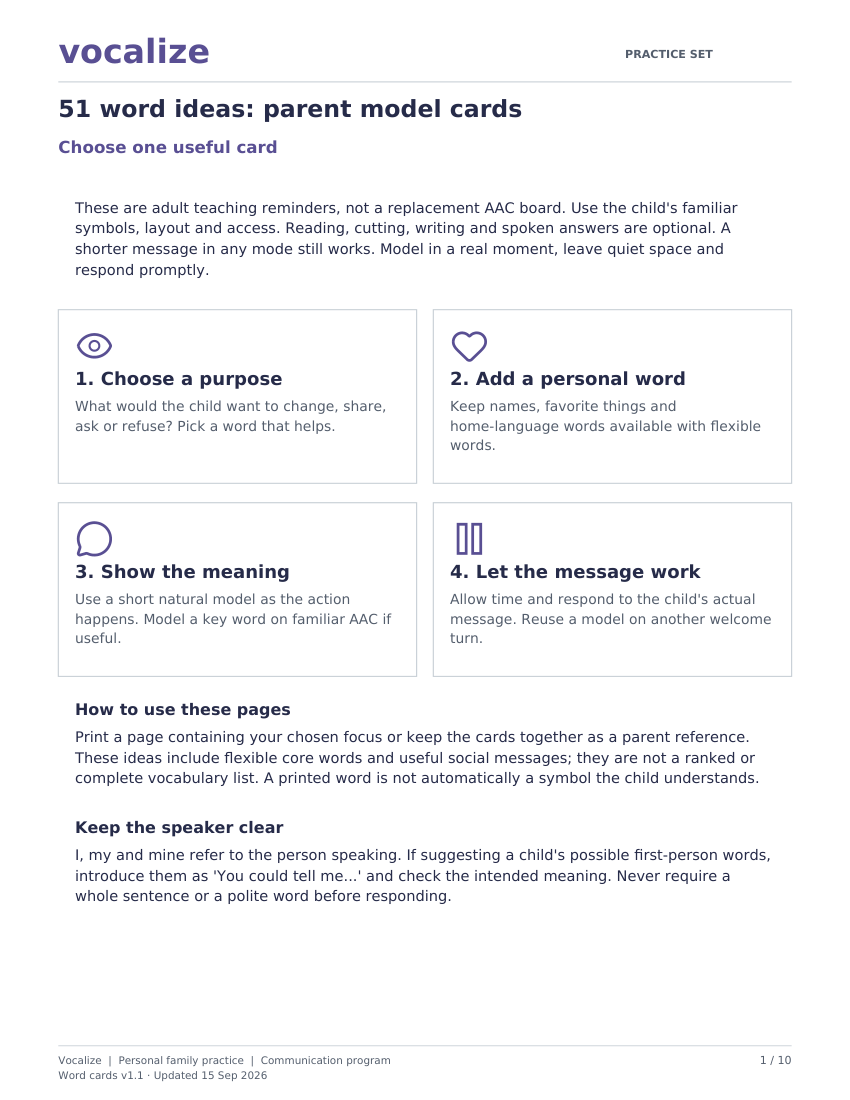
The printable word-card guide: choose a purpose, add a personal word, show the meaning and let the message work.
51 word ideas: parent model cards. Enlarge this guide page.
Activity companions
442
Lesson companions
156
Additional practice sets
40

638 printable resources in total: one companion for each of the 442 activities and 156 lessons, plus 40 additional practice sets. These are resources, not page counts; each can contain several pages. Letter and A4 are paper-size options, not extra resources. Print only what helps today.

BEFORE YOU CHOOSE

Is this for us?

For parents of late talkers, autistic children and children building early communication skills. A diagnosis or spoken-language milestone is not required to try the communication activities.

What if my child uses few or no spoken words?

Start with connection, choices or getting help. Gestures, sounds, signs, AAC and speech all count. Keep your child's familiar communication tools available; the goal is a message that works.

How much time do we need?

A short, comfortable moment can be enough. The 5-, 10- and 15-minute plans include adult preparation and reflection. Split a plan, repeat a useful idea or stop early.

Can we use our family's language?

Yes. Adapt communication models into the words and natural sentences your family uses. Instructions and downloads are currently in English. English letter-and-sound worksheets need different examples for other languages.

Does my child need to use the app?

The guidance is for the adult. Read it, then try it in everyday life. Your child's own AAC or communication app stays available.

Can we join yet?

Paid enrollment is not open. You can try the three free examples now and join the launch-update list.

Where can I find cancellation and refund information?

The planned subscription includes online cancellation of renewal. Final purchase and refund terms will be shown before enrollment opens. Read the membership terms or ask a membership question.

PLANNED MEMBERSHIP · ENROLLMENT NOT OPEN

One program. Two planned ways to pay

See the proposed membership before signing in. Both options include the full self-guided program.

Monthly

$19USD / month

Planned monthly billing

A shorter commitment, with the full program.

Annual

$149USD / year

Planned annual billing

A full year of access to the same program.

Save $79 per year. Compared with 12 months at the planned monthly price.

Paid enrollment is not open yet. These are planned prices in US dollars. Final pricing, renewal and cancellation terms will be available before you choose to subscribe.

Included with either planned option

  • Step-by-step communication activities and parent lessons
  • 5-, 10- and 15-minute plans, with shorter options
  • Visual guidance, exact wording and practical adjustments
  • Downloadable companions for every activity and lesson
  • Saved activities, favorites and communication observations
  • Separate behavior and mealtime education sections

Hear when Vocalize opens

Leave your email for launch updates. No payment or child details needed.

Only your email, request topic and consent are saved. How we use this information.

See plans & pricing